Capital Gains Taxes on Homes in Texas
Before you put the “for sale” sign in your front yard, it’s important to be aware of capital gains taxes on homes in Texas.


The San Antonio housing market is hot, so now is the time to sell your home if you are looking to maximize a profit and invest your finances elsewhere. But before you put the for sale sign in your front yard, it's important to be aware of what the Texas capital gains tax means for you and your home.
WHAT ARE CAPITAL GAINS TAXES?
When you buy anything of value—such as stocks, cars, homes, or one-of-a-kind artwork—you might be subject to a long-term capital gains tax when it comes time to sell that high price tag item if the value has increased. If you bought a painting for $100,000 and later sold it for $150,000, that $50,000 profit is taxable.
If you own an item for a short amount of time when you sell it, you may have to pay short-term capital gains, which are generally taxed higher as well as being taxed as ordinary income. We’ll get into the specific timeline of ownership for real estate further below.
The Taxpayer Relief Act of 1997 protects many homeowners from having to pay up. But if your primary home drastically appreciates in value from the time you bought it to the point of resale, there’s a chance you’ll have to pay long-term capital gains taxes. As home prices continue to surge in the San Antonio area, your home’s increased market value could mean that a capital gains tax payment is coming your way.
WHAT YOU MIGHT OWE IF YOU SELL
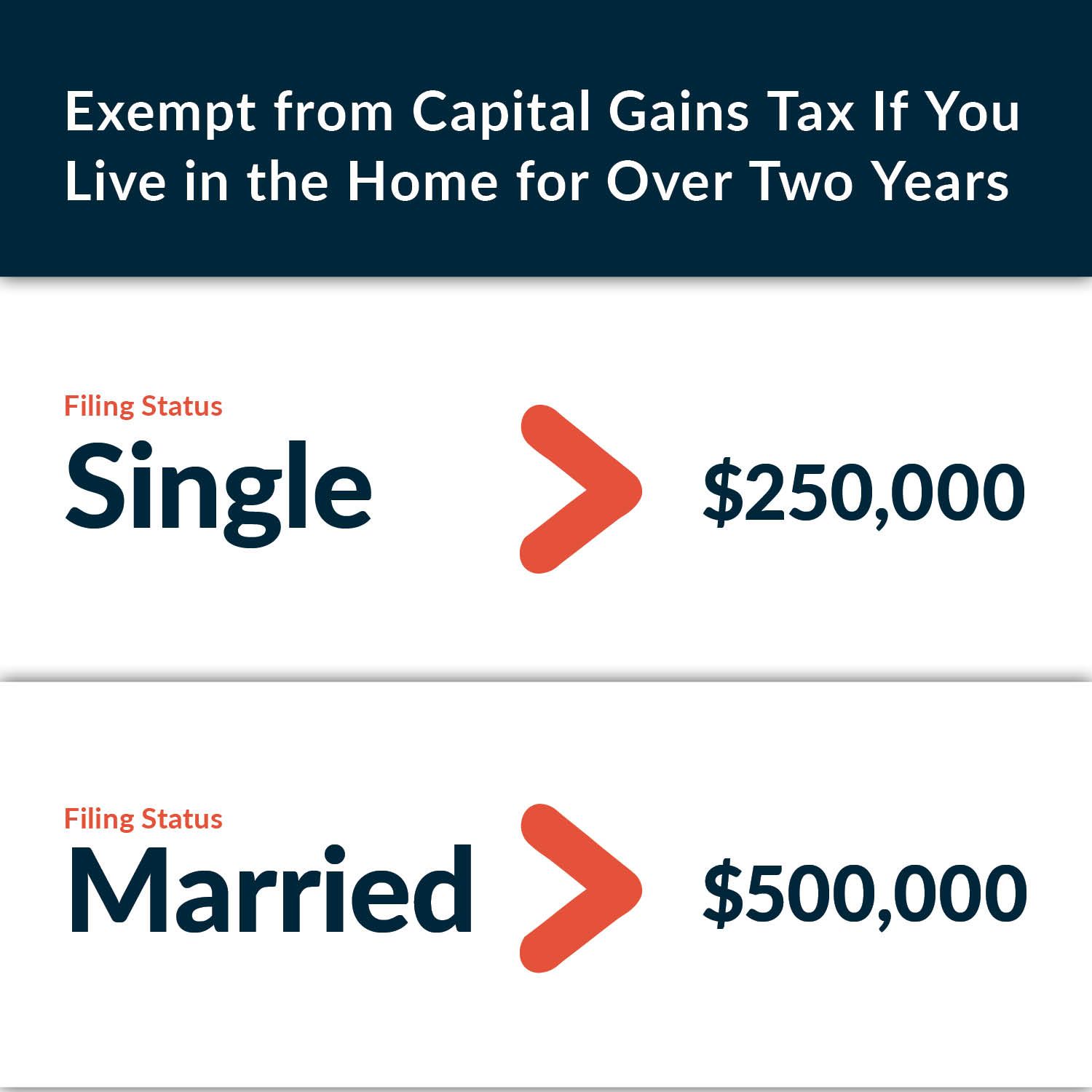
What you owe to the Internal Revenue Service (IRS) depends on what you earn from the sale, if you are filing jointly, and your income bracket. In order for capital gain tax exemption to apply, homeowners must live in the home for at least two years and it must be considered their primary residence. Second homes or vacation homes do not apply to this exemption. Additionally, the Taxpayer Relief Act of 1997 stipulates that you can only use this exemption every two years.
If you are single, homeowners are exempt from capital gains tax if they made less than $250,000 in value. Those who are married and file together are exempt if they made less than $500,000 on the sale of the home.
If a homeowner sells their home for over $250,000 or $500,000 over what they originally bought the home, the homeowner could be subject to the tax. The tax is only applied to the amount the home appreciated over the exemption amount. For example, if a single homeowner made $300,000 over what they originally paid, the tax would only be on the extra $50,000—not the full $300,00. You can also use a capital gains tax calculator on the sale of property to estimate how much you would owe.
CAPITAL GAINS TAX RATES FOR 2022
The tax rate a homeowner must pay depends on their taxable income. According to data from the IRS, the tax rate on most net capital gain is no higher than 15% for most individuals. Some or all net capital gain may be taxed at 0% if your taxable income is less than or equal to $40,400 for single or $80,800 for married filing jointly or qualifying widow(er).
A capital gain rate of 15% applies if your taxable income is more than $40,400 but less than or equal to $445,850 for single; more than $80,800 but less than or equal to $501,600 for married filing jointly or qualifying widow(er); more than $54,100 but less than or equal to $473,750 for head of household or more than $40,400 but less than or equal to $250,800 for married filing separately.
However, a net capital gain tax rate of 20% applies to the extent that your taxable income exceeds the thresholds set for the 15% capital gain rate.
DO I HAVE TO PAY CAPITAL GAINS TAXES IN TEXAS?
Texas does not have a unique capital gain tax because this specific tax is filed through the IRS. This means you pay capital gains taxes at the federal level, and not through state taxes. No matter where you live in the United States, you will be taxed based on the appreciated value and receive your tax rate through your income bracket.
HOW CAN I AVOID PAYING CAPITAL GAINS TAX ON MY HOUSE?
In San Antonio’s current market, you’ll likely make more for your home than you purchased it for. In the case that you profit, you’ll be taxed for the capital gain. If you’re wondering how to avoid capital gains tax on real estate, one way is to not accept an offer over $250,000 (or $500,000) of what you originally paid on the home so that you qualify for the exemption. If you made large home improvements or added additions to the home, your cost basis will also reduce the capital gains you would potentially make on the sale.
Additionally, homeowners can reinvest their proceeds into 1031 exchanges to avoid paying capital gains taxes on homes in Texas by putting it into a similar property. A 1031 exchange allows you to defer the tax on the home through a like-for-like exchange. 1031 exchanges are commonly used for businesses, so talk to your accountant if you want to consider this option.
You can also use tax losses where something depreciates to offset your capital gains. If you invest in real estate, it may benefit you to sell some of your investments at a loss to offset the gains you have made on other investments. According to Forbes, this is known as tax harvesting. If you want to attempt this to impact your capital gains tax, it is best to speak to a tax professional.
One of the best ways to understand and make sense of the complexities of selling your home is to work with an experienced real estate agent. You can also get a comprehensive analysis of your home’s value in today’s market using Realty San Antonio’s Market Snapshot tool.
Related Articles
to Top