San Antonio Housing Market Report April 2026
April brought measured growth to the San Antonio metro area. Rich inventory and deliberate valuations are creating a healthy market for both buyers and sellers.

Staying informed about the San Antonio housing market is crucial, whether you're looking to buy or sell. See what’s happening in the San Antonio housing market and how broader economic trends and local activity are creating a more balanced and confident real estate environment.
Unlike the volatility seen in other major hubs, the San Antonio metro is entering a period of healthy equilibrium. With abundant inventory, an accelerating seasonal pace, and more intentional pricing from sellers, April was defined by predictability and measured growth. Today, San Antonio offers a sustainable landscape where success is defined by the ability to navigate the nuances of a balanced market.
Let's look at April’s numbers:
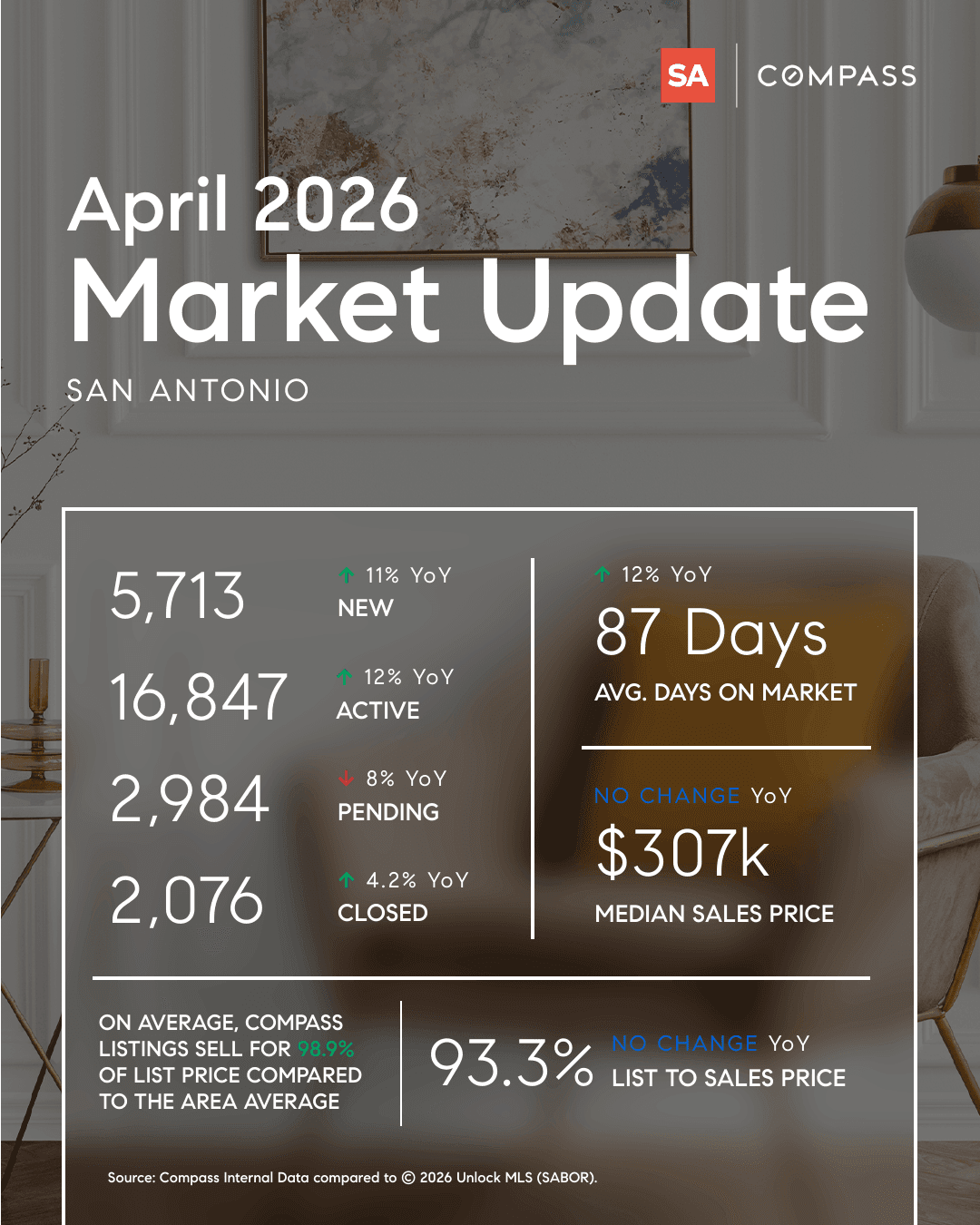
- Active Listings — San Antonio finished April with 16,847 active listings, 12% higher year-over-year and a 6% increase month-over-month.
- Home Prices — The median home price held at $307,000, at the same level year-over-year and a 3.1% decrease from March.
- Days on Market — Homes spent an average of 87 days on the market, which is 12% longer than last year and 12% days shorter than last month.
- Pending Sales — Pending sales totaled 2,984, down 8% year-over-year with a 0.9% increase month-over-month.
- Closed Sales — There were 3,135 closed sales, 2% higher than a year ago and 1.1% higher than March.
- Housing Inventory — Inventory reached 6 months, which is 0.3 months higher than last month.
Source: San Antonio Board of REALTORS®, All MLS.
Outperforming National Trends
While the national housing market experienced a sluggish start to the spring season, the San Antonio metro area showed significantly more vigor. Nationally, existing home sales saw a marginal 0.2% increase compared to March and remained flat year-over-year. In contrast, San Antonio outpaced the country with a 1.1% monthly increase and a 2% rise over last year.
This divergence from national trends is driven by long-term structural demand. One of the primary factors is household growth: San Antonio’s household growth has surged 27.9% over the past decade, double the national rate of 13%. Crucially, this expansion is not limited to a single demographic; it spans all age groups and homebuyer profiles. As a result, housing demand remains strong and steady across the entire spectrum, from entry-level new builds to high-end move-up properties.
Rate Normalization Fuels Sustained Demand
While March was defined by geopolitical anxiety, April marked a slight shift in buyer psychology. As mortgage rates stabilized in the 6.3-6.4% range, buyers began accepting the new normal rather than waiting for a return to historic lows. Consequently, borrowers are increasingly prioritizing market stability over specific rate levels as they move forward, with mortgage applications increasing in April compared to March.
In the San Antonio metro area, this shift in perception has resulted in a more measured spring season. With a total of 3,135 contracts signed, activity is up 1.1% month-over-month, signaling that while the pace is deliberate, the market remains on a steady upward trajectory. While rates remain higher than in years past, they are no longer the primary barrier for those focused on homeownership.
Spring Velocity and Sub-Market Dynamics
Another indicator of continued buyer confidence in San Antonio is the market's accelerating pace. In April, homes spent an average of 87 days on the market, marking a significant 12% drop from March. However, savvy real estate experts recognize that this average doesn’t reflect the reality on the ground for new inventory. This velocity is highly dependent on the specific sub-market and property type. Stagnant overpriced winter listings, rural properties, and luxury listings naturally stay on the market longer and pull the metro average upward, while fresh and correctly priced homes in suburban and urban areas are moving at an entirely different speed. Active buyers should keep this distinction in mind, as the most desirable homes continue to disappear fast.
Strategic Pricing and Shifting Away from Deep Discounts
With the median home price reaching $307,000, properties in the San Antonio metro area are selling for an average of 93.3% of the original list price, which is a slight climb from March’s 92.8% ratio. While Realtor.com reports that almost one in four listings has undergone a discount, this volume signals a necessary market realignment. All signals considered, sellers are increasingly moving past the test-the-waters approach in favor of data-backed pricing.
With housing supply reaching 6 months, the market is evenly balanced. In this abundant landscape, an accurate valuation is a seller’s primary tool for standing out. While buyers still enjoy more time and leverage than in years past, they must come to the table prepared for today’s realities and expect less room for heavy negotiation.
Prepare for Your Next Move
Success in San Antonio’s distinct climate depends on looking past the broad headlines and leaning into the local nuance. To come out on top, trade market-timing anxiety for a well-executed, data-backed strategy. A Realty San Antonio Compass expert can serve as a bridge between complex market trends and your specific goals, offering the precision and insight this busy season demands.
For the latest market updates, follow us on social media @realtysanantoniocompass. Subscribe to our market newsletter by clicking "sign up" in the top right corner of our website.
to Top